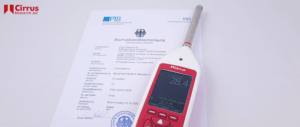
Testing fire alarm sounders to BS EN 5839If you’re measuring the noise level from fire alarm sounders in accordance with BS EN 5839, the sound level meter that you use must meet a specified standard, BS EN 61672-1:2003, and must display the level in dB(A) using Slow Time Weighting.

The instrument should meet at least Class 2 of BS EN 61672-1:2003 although a Class 1 instrument would also be suitable as this is more accurate than a Class 2 instrument.

A summary of this is as follows:

  • Standardisation: BS EN 61672-1:2003 Class 2 (A Class 1 instrument is also acceptable)
  • Frequency weighting: dB(A)
  • Time Weighting: Slow

Sound level meter with calibratorWe would recommend a CR:152A Class 2 optimus yellow sound level meter from the optimus range as this will give you all of these requirements in a simple to use package.

One advantage of the optimus sound level meters is that the display can be easily read in low light conditions and the keypad will light up to make sure that you can see the keys.

If you are testing a large number of sounders or if you need to store the measured noise levels for reference and record keeping, it may worth using a sound level meter that has data logging such as the CR:152B optimus.

This will allow the individual noise levels from each sounder to be stored and the information downloaded to the NoiseTools software. If you have a large number of tests to do then this may be a quicker and more convenient solution than writing down each measurement as you make it.

As with any noise measurement equipment, we would recommend that you use an Acoustic Calibrator before and after each measurement. This ensures that your instrument is measuring noise levels correctly and that it is operating as expected.

If you would like more information about the optimus sound level meters click here to contact us

270xblog-cta-can-we-help


Related posts:

What’s the difference between a Class 1 and Class 2 Sound Level Meter?

The optimus sound level meterFinding the best sound level meter for your application can often be a challenge. There are hundreds of different models and makes available, each with a wide range of functions and features, some of which you may need and some which you may not.

To help you choose the best optimus sound level meter for your application and needs, we’ve updated our Optimus Product Selector with a range of new functions, features and specifications.

You can choose from a range of applications, features or functions and use any combination of these to find the instrument that suits you best.

As you make your choices, the selector will remove instruments that don’t match your requirements and once you’ve finished, you can click on any of the remaining optimus sound level meters to get more information.

So whether you’re looking for a Class 1 data logging sound level meter with 1:3 Octave Bands, Audio Recording and Tonal Noise Detection or a Class 2 sound level meter for Noise at Work, the optimus product selector can help you find the right instrument.

The optimus sound level meters are designed to the requirements of the very latest standards and many of the instruments carry Type Approval. If you would like to know more about Type Approval, there are several posts on the blog that you can read. Details of these are at the end of this post.

Find your ideal optimus in French, German & Spanish

The optimus selector is available on the Cirrus Research website and also in French, German and Spanish via the links below:

Selecteur de produit optimus (FR)

Optimus Geräteauswahl (DE)

Seleccionador de producto optimus (ES)

Click on the image below to get started

Find your ideal optimus sound level meter


Would you like more information?

If you would like any more information about our products or if you would like help in choosing the best noise measurement instrument for you, please call us on 0845 230 2434 or email us at sales@cirrusresearch.co.uk and we would be pleased to help.

Related posts:

What is Type Approval?

560xtrojan2-slide2

Cirrus Research is pleased to announce the launch of the new version of the Trojan Noise Nuisance Recorder, the Trojan2.

Designed specifically for the measurement and monitoring of noise nuisance, the Trojan2 is quick and simple to setup and gives you the all of the noise measurement data and audio recordings needed to effectively assess noise complaints.

The original Trojan was designed using feedback from existing customers and users of noise nuisance recorders and we incorporated a range of features and functions that these users requested.

The new version of the Trojan, the Trojan2, adds even more functions and features including:

  • Quicker and simpler removal of the cables for transport and storage
  • Less cables to connect to the sound level meter
  • More space in the case for storing accessories
  • A simple way to add a wired hand switch if needed

We’ve also made a number of updates to the software inside the Trojan to allow measurements to be made over longer periods of time as well as making download of measurements quicker.

Key features of the Trojan2 Noise Nuisance Recorder

Quick, simple and easy to set up

When you are deploying a noise nuisance recorder, it’s vital to know that you’ll get good quality recordings and noise measurement data. With the Trojan2, there’s no need for step-by-step instructions as it’s just a matter of plug in, calibrate and you’re ready to go.

If you forget to press start, the instrument will automatically start measuring after 10 minutes.

Fixed cables

Once the case is locked, the power cable and microphone cable are fixed so there’s no risk of the cables being pulled out either accidentally or deliberately.

The worst thing that can happen is that the power cable is pulled out just after you’ve left so that you only get a few hours data until the batteries go flat. The Trojan2 avoids these issues whilst maintaining the ease of use demanded by our customers. The cables can be quickly removed for transport and storage so there’s no risk of damaging the cables during transport or storage.

High quality, high resolution audio recording

The standard audio recording on the Trojan2 uses a 16bit/16kHz uncompressed WAV file.  This gives you plenty of frequency range (up to 8kHz) and a wide dynamic range (up to 96dB) so your audio recordings can handle both high and low levels with no loss of quality.

This is vital if you want to capture both low levels at night and higher levels during the day (such as doors banging or music playing) and be able to clearly identify what was the source of the noise.  There’s also no risk of overload or under-range in your measurements or audio recordings.

There’s an option to store audio at 32bit/96kHz quality for the ultimate in fidelity and this may be useful if you are going to use the sound level meter out of the case.

4GB memory

Each Trojan2 is supplied with a 4GB memory as standard. This is usually more than enough for most applications but it can be expanded with a 32GB option. We don’t use removable memory cards as there’s a risk that they can be lost, corrupted or damaged.

With the Trojan2 you can also guarantee the chain of data from the instrument to the software, a useful feature if you need to present measurements and recordings as evidence.

Pre & Post Trigger options

The pre and post trigger times for the audio recording can be set as needed. The pre trigger can be up to 30 seconds and the post trigger can be up to 60 seconds. Both of these can be disabled if your procedures require it but you get full control over what suits you best.

Licence free software

The NoiseTools software is supplied, as standard, free of charge and without any installation or licencing restrictions.  You are free to install the software onto as many desktops, laptops or servers as you need and there’s no extra cost.  Updates are free of charge as well so there’s no on-going cost with the software.

Made & Supported in the UKDesigned, Manufactured & Supported in the UK

The Trojan2 has been designed and manufactured by Cirrus at our factory in North Yorkshire from where we provide the support, training and backup direct to our customers.

This means that if you have any questions, you can speak to the team who designed the Trojan2 as well as having direct access to your sales contacts as and when needed.

15 Year Warranty from Cirrus Research15 Year Warranty

All of our noise measurement equipment is backed by our 15 year warranty.  Each time your instrument is calibrated by us, we’ll extend the warranty by a further 12 months.

Don’t forget that our warranty covers accidental damage as well as all of the accessories and options supplied with the kit.

This means that if you damage a cable and your instrument is under warranty, you’ll get the replacement free of charge.

Download the Trojan2 overview and find out more.

When the audience sits in the beautiful auditorium of Jersey Opera House, they have very little idea of the technology that goes into giving them the ultimate live show experience.

Whether they have come to see stand-up comedian Kevin Bridges or a full stage production of New Jersey Nights, the quality and right level of sound are absolutely crucial.

695xjoh1

Photo: Joshua McDowell

Jersey Opera House Technical Manager Chris Wink has used Cirrus products for a number of years to monitor and record sounds level within the auditorium for both quality and H&S regulations. When he needed to upgrade he chose the Cirrus Optimus Red sound level meter.

It gives Chris and his team the very latest digital technology and industrial design, proving ideal for his specific type of noise measurement needs in a work place that relies on pitch perfect sound for every performance.

“Obviously we need to comply with all the health and safety regulations but we also need to respond to customer comments about the quality of sound during performances,” explained Chris.

“Jersey Opera House is in use for approximately 70% of the year – for at least 4 days every week - and features every type of show from full on rock bands to one-man performances. In every show the sound is critical for the audience’s enjoyment. We have to comply with all the guidelines and we want to make sure the noise is at a comfortable level for the audience, for example, if it’s a children’s show then we want to ensure that noise levels are much lower than for an adult audience.”

Find out more about how Jersey Opera House uses the optimus red sound level meter to manage and monitor noise levels.

Click here to download the full Case Study.

695xjoh2

Photo: Stephane Gimenez

Cirrus Research, le spécialiste de la conception et de la fabrication d’instruments de mesure du bruit, a reçu l’Homologation du LNE pour les sonomètres optimus rouge et optimus vert de Classe 1.

Cette nouvelle certification atteste de la conformité à la norme NF EN 61672-1:2003 pour un sonomètre de Classe 1. Les sonomètres optimus détiennent également l’homologation du PTB en Allemagne pour la norme DIN EN 61672-1 et Applus + en Espagne pour UNE EN 61672.

Les sonomètres optimus utilisent la toute dernière technologie numérique pour proposer une mesure de bruit aussi simple et précise que possible.

Tous les paramètres sont mesurés simultanément et grâce à leur gamme dynamique étendue de 120 dB, leur écran couleur OLED haute résolution et leur mémoire de 4 Go, les sonomètres optimus sont très faciles d’utilisation tout en maintenant les plus hauts niveaux de performance.

Les optimus rouges ont été conçus pour la mesure du bruit au travail et l’hygiène industrielle, tandis que les optimus verts sont l’option idéale pour les mesures du bruit tant environnemental qu’au travail.

Les sonomètres optimus de Classe 1 peuvent être utilisés avec le calibreur acoustique de Classe 1 Cirrus CR: 515 qui est également homologué par le LNE pour la norme CEI 60942:2003.

Vous trouverez plus d’informations sur les sonomètres optimus et le calibreur acoustique CR: 515 en consultant le site Web  www.cirrusresearch.fr

250xLNE-logoWe’re pleased to announce that the optimus red and optimus green sound level meters are now available with  Type Approval from the LNE in France.

This new certification demonstrates compliance with NF EN 61672-1:2003 for a Class 1 sound level meter. The optimus sound level meters also carry Type Approval from the PTB in Germany to DIN EN 61672-1 and Applus+ in Spain to UNE EN 61672-1.

Certificat d'examen de type - optimus red & optimus greenThe LNE Type Approval covers the following versions of the optimus sound level meters:

Optimus Red

  • CR:161A Class 1 optimus red sound level meter
  • CR:161B Class 1 optimus red sound level meter with data logging
  • CR:161C Class 1 optimus red sound level meter with data logging & 1:1 octave band filters

Optimus Green

  • CR:1710 Class 1 optimus green sound level meter with data logging & audio recording
  • CR:171A Class 1 optimus green sound level meter with 1:1 octave band filters,  data logging & audio recording
  • CR:171B Class 1 optimus green sound level meter with 1:1 & 1:3 octave band filters, data logging & audio recording

These Class 1 Sound Level Meters are available with the CR:515 Class 1 Acoustic Calibrator which also carries LNE Type Approval and PTB Type Approval.

Details of the optimus red and optimus green sound level meters are available from the following websites:

English
German
French
Spanish

Related Posts:

What is Type or Pattern Approval?

AuditStore Data Verification

PTB Type Approval for the Optimus Sound Level Meters

LNE Type Approval for the CR:515 Class 1 Acoustic Calibrator

Tonal Noise Detection with the optimus green sound level

Continue reading »

Cirrus won a Highly Commended award for the Best Stand Competition at Safety & Health Expo held at the NEC Birmingham in May!

Cirrus Research saw off tough competition to be crowned Highly Commended in the first ever Best Stand competition. This year saw the return of the tardis and the introduction of the Noise Doctors, who were on hand throughout the three days to offer advice and information on the Cirrus Research range of noise measurement instruments.

Judges of the Best Stand competition commended Cirrus Research on their visually striking stand and staff who  actively encouraged visitors to enter the “Play your noises right” competition and try out their Optimus and doseBadge ranges.

Commenting on receiving the award, James Tingay, Group Marketing Manager at Cirrus Research said: “We thoroughly enjoyed our time at Safety & Health Expo and feel honoured to have received this award; it is a testament to the dedication and hard work from everyone at Cirrus Research that helped to produce what is now an award winning stand.”

James continued: “Launching the Noise Doctor at the Safety & Health Expo was the ideal platform for Cirrus Research; it meant that we were able to meet our customers face-to-face and offer them the best solution to their noise measuring issues. We would also like to congratulate SHE Software Ltd on being the winners of the Best Stand competition.”

Follow Cirrus Research on Twitter @cirrusresearch to keep up-to-date on the very latest from the Noise Doctor

Cirrus Research at the 2013 Safety & Health ExpoWe’re delighted to announce that the Cirrus Research stand at this years Safety & Health Expo has received the Highly Commended Award in the Space Only category! (Well done to SHE Software Ltd who won the 1st prize).

We’d like to thank everyone involved in the design and build of our stand this year including all of the team at ICM Creative and Moda.

This year we introduced the Noise Doctors who were on hand to provide advice and information about our range of noise measurement instruments as well as advice on how best to make noise measurements.

We also presented “BANG! And the Noise is gone!” in the ARCO Academy where we demonstrated how loud some common noises really are and how long you can be exposed to them. 2013 was a successful show for the Noise Doctors and we’re looking forward to 2014 and the move to the Excel in London.

We’re currently collating the entries for the competition that we ran on the stand so if you entered, we’ll be in touch shortly to let you know if you’ve won one of the fantastic prizes.

If you’ve got any comments or questions from the show or if we can offer you any information or assistance, please do get in touch and we’ll be pleased to help.

See you all next year!

The Noise Doctors.


Cirrus Product Training CoursesTo meet demand from our customers, we’ve added a set of new dates for the CPTC or Cirrus Product Training Course.

Our courses are held at a number of venues across the UK including the Brands Hatch Circuit, Oulton Park Circuit, The East Midlands Conference Centre and the Castle Combe Circuit.

These courses are the ideal opportunity for you to learn how to get the best from your noise measurement equipment.

Although there is an outline to the courses, each course will be tailored to meet the needs of the delegates. We may focus more on the software or the optimus sound level meters, depending upon what each delegate wants to get from the day.

The course tutors will be able to discuss with you before the day what you would like to cover. There’s plenty of time for discussion over refreshments as well as at the end of the day.

The current dates for the course are:

  • Tuesday 4th June 2013  - MacDonald Hotel, Falkirk
  • Wednesday 19th June 2013  - Oulton Park Circuit, Cheshire
  • Thursday 27th June 2013  - Brands Hatch Circuit, Kent
  • Wednesday 3rd July 2013  - Castle Combe Circuit, Wiltshire
  • Wednesday 10th July 2013  - The East Midlands Conference Centre
  • Thursday 10th October  - Castle Combe Circuit, Wiltshire
  • Wednesday 23rd October  - Oulton Park Circuit, Cheshire
  • Tuesday 12th November  - The East Midlands Conference Centre
  • Tuesday 19th November  - Brands Hatch Circuit, Kent

Demand for places is high so we would recommend booking early to guarantee your place and you can book your place on-line through our website.

For further information please call Craig Storey on 01723 891655 or visit the training pages on our website at www.cirrusresearch.co.uk/training

250xappluesWe’re delighted to announce that the optimus red and optimus green sound level meters have been granted Type Approval to UNE-EN 61672 Parts 1 & 2 in Spain by Applus+, one of the world’s leading testing, inspection and certification companies.

CERTIFICADO DE EXAMEN DE MODELO CR:161 Optimus Sonómetro UNE-EN 61672After a series of long and detailed tests, which include both electrical and acoustic verification, approval numbers have been issued for the Class 1 optimus green and optimus red instruments as follows:

CR:161A, CR:161B & CR:161C
CR:1710, CR:171A & CR:171B

The approval numbers are:

No. 02-001-B-62/13-R  the CR:161 (optimus red) sound level meters

No. 02-001-B-63/13-R CR:171 (optimus green) sound level meters

The standards that were used in the verification were:

CERTIFICADO DE EXAMEN DE MODELO CR:171 Optimus Sonómetro UNE-EN 61672UNE-EN 61672-1: electroacústica : sonómetros. Parte 1, Especificaciones
UNE-EN 61672-2: electroacústica : sonómetros. Parte 2, Ensayos de evaluación de modelo

What is Type Approval?

Type Approval, or Pattern Approval, is a method where a test laboratory such as the Applus, PTB or LNE tests an instrument against a set of standard tests to ensure that it meets the performance claims of the manufacturer.

The optimus sound level meters have been designed to meet the requirements of IEC 61672 (and the corresponding UNE-EN, EN and DIN standards) and so these independent test have been carried out to verify that that the instruments do indeed meet these requirements. The IEC 61672 standard is in three parts.

The first of these is known as Electroacoustics – Sound level meters – Part 1: Specifications  and this defines the performance specifications for the instruments.

Part 2 is known as Electroacoustics – Sound level meters – Part 2: Pattern evaluation tests and this defines the tests and checks that a laboratory must carry out when they are testing an instrument for Type or Pattern approval. These are the tests that the PTB have been carrying out on the optimus sound level meters.

Part 3 is known as Electroacoustics – Sound level meters – Part 3: Periodic tests  and this defines the tests that should be carried out during a Periodic or routine verification.

This post has more information about the different sections of the IEC 61672 standard.

Related Posts:

What is Type or Pattern Approval?

Updated Type Approval for the Cirrus Optimus Green Sound Level Meters

AuditStore Data Verification

PTB Type Approval for the Optimus Sound Level Meters

Tonal Noise Detection with the optimus green sound level meters

© 2013 NoiseNews